


Blog
Semi-automatic vs Automatic Food Machines
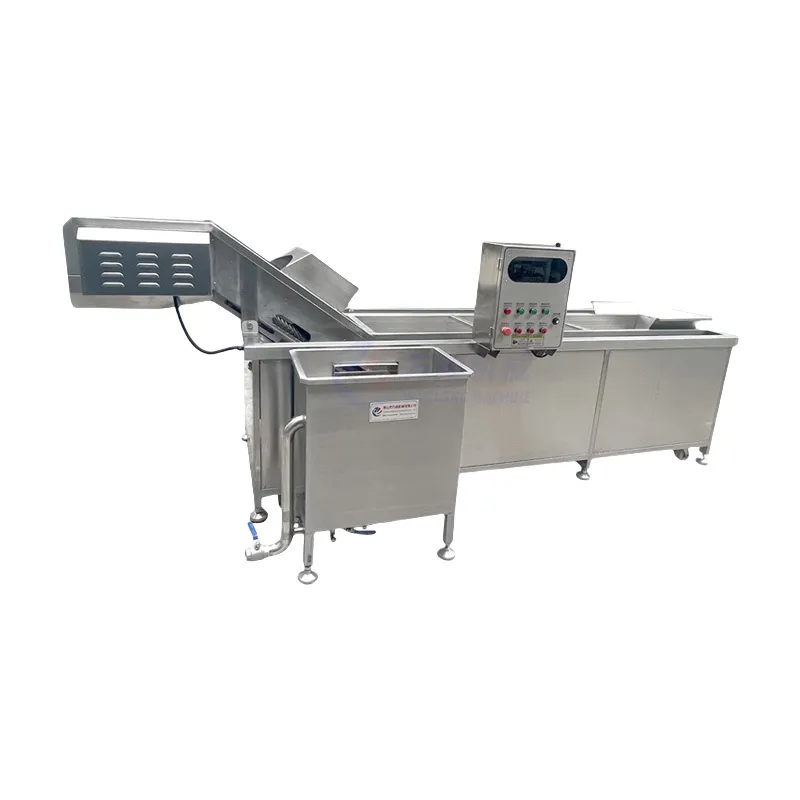
Food manufacturers today face rising labor costs, tighter hygiene regulations and increasing production demands; choosing the appropriate equipment therefore becomes an integral business decision. One question consumers frequently pose to prospective purchasers is “Should I purchase a semi-automatic or automatic food machine?”
Each option provides unique advantages depending on a factory’s size, budget, product type and future expansion plans. Semi-automatic machines may be better suited to startups and smaller firms looking for lower investment costs; fully automatic machines provide greater efficiency with consistent output while decreasing labor requirements.
Food processors rely on us to find the right solutions for meat and vegetable processing, including frying systems, blanching systems, washing systems and complete production lines.
What are semi automatic food machines?
Semi automatic food machines combine automatic processing with manual operator assistance to form hybrid machines that combine automation and human assistance for processing food products. While the machine handles most mechanical tasks, workers can still load raw materials or unload completed items or modify settings between batches as necessary. Common examples of semi automatic food machines are vegetable cutters, meat slicers, peeling machines, filling machines and packaging machines (all known as semi automatics).
Small and midsized food businesses rely on semi-automatic frying systems as they offer the optimal balance between productivity and cost. Semi-automatic systems typically represent medium capacity investments requiring partial operator involvement.
What are fully automatic food machines?
Fully automated food machines require little manual input. Raw materials are fed into the system and multiple stages such as washing and cutting, cooking and conveying, weighting and packaging are automated by the system.
Some examples include Automatic Vegetable Washing Lines; Automatic French Fry Production Lines; Automated Meat Cutting Lines and Continuous Fryer Lines as well as Automated Blanching Systems that automate their processes automatically.
Automatic packaging lines (APLs) are increasingly being implemented by large factories that prioritize speed, consistency and 24/7 operation. According to industry studies, fully automatic systems tend to be the best fit for high-volume manufacturing environments.
Automatic and Semi Automatic Machines: Differences and Similarities
- Initial Investment
Semi-automatic machines can be attractive options for startups and growing businesses due to requiring less initial capital outlay.
Automated systems tend to be more costly in the short term due to their inclusion of conveyors, sensors and PLC controls as well as integrated motors with multi-stage synchronization capability. They’re best suited for long-term scale plans with full automation. Our suggestion: for limited budgets: semi automatic and for long-term scale plans full automation are recommended as your best choices for maximum flexibility and performance.
- Work Requirement
Semi-automated equipment still requires operators interaction for loading, unloading, inspecting or switching processes.
Automated lines reduce labor and redirect it toward supervision and quality control. Numerous industry sources have consistently compared semi-automatic systems to fully automatic ones, citing their increased labor needs as evidence for choosing one over the other. Its Best Pick: mes Semi-automatic may be suitable in areas with lower labor costs.
Automatics often win in areas with higher labor costs, and their productivity capacity makes them ideal for small batch production and moderate daily volumes. On the other hand, semi-automated systems offer great versatility when applied to smaller-batch production or moderate daily volumes.
Automated systems tend to offer greater throughput for mass production in continuous mode than semi-automatic alternatives, making them the better option for mass production in continuous mode. They may be best for: Small orders/custom batches – Semi automatic; Automatically/Large contracts/supermarket supply. This ensures product consistency throughout production runs.
Automated machines have the capability of maintaining consistent speeds, temperatures and times with programming; as well as producing more uniform products. Semi-automatic systems rely more heavily on operator skill during long shifts; examples being: Fries with equal sizes that have stable blanching times as well as color uniform frying conditions. They produce consistently packaged weight products. And finally, there are semi-automatic systems which rely more on operator experience compared to automated ones; such as when packing fries. They include: Semi-automated machines make switching products or batches simpler, while automated lines may need adjustments made to their recipes, tools and conveyor systems.
Best Choice:
Many SKU changes – Semi automatic
Automatic – One product, all day.
| Factor | Semi Automatic Food Machines | Fully automatic food machines |
| Initial Cost | Lower Prices | Higher |
| Work Need | Medium to High | Low-cost |
| Capacity | The Medium | High-quality |
| Consistency | Good | Excellent |
| Product Changeover | Fasten your seat-belts | Moderate |
| Maintenance | Simpler | More Technical |
| Best for | Startups / SMEs | Large Factories |
| ROI Speed | Faster forward | Better long-term |
Which industries favor semi-automatic machines?
Semi-automatic solutions are extremely popular among various industries: Central kitchens, New Food Brands, local frozen food suppliers, starting production at restaurants chains and seasonal processors launching products or trials of product launches are just a few examples where semi-automatic solutions may prove useful.
Growing vegetable processing businesses typically start off with: A semi-automatic washer, vegetable cutter, air dryer and packing station may all form the base for their operations before upgrading to fully automatic lines over time. Fully automated lines are commonly seen in French Fry factories, frozen vegetable plants, meat processing facilities and prepared meal manufacturers as well as exported prepared meal manufacturers, prepared meal manufacturers export and food processors as well as contract packaging factories.
Customers of Wanlong Machine Co. Ltd. require high-quality output at lower unit costs with rigorous hygiene controls.
Wanlong assists customers in selecting the appropriate solutions by considering:
Daily capacity goals, labor costs in their country, product type size/type utility supply plans expansion budgets
Automatic, semi-automatic or phased upgrade options may be considered depending on your business needs.
Our recommendations may include automatic, semi-automatic or phased upgrades. In our experience, successful customers typically begin their sales channels with semi-automatic machines before upgrading later.
As an example:
Year 1 – Semiautomatic Washing + Cutting + Packaging * This helps mitigate risk while protecting growth potential. Years 2-3: Conveyor + Automatic Weighting * This reduces risks while safeguarding growth potential.
Future Trends in Food Processing Automation
Global buyers are becoming increasingly demanding: Touch screen PLC controls for recipe memory systems; water-saving washing systems, energy-efficient fryers and vision inspection systems for vision are just some of the features demanded of food processing automation lines. And modular expansion lines may offer solutions.
Automating food production is no longer limited to large factories alone.
Conclusion of Article :
There is no single solution when it comes to selecting between semi-automated and automatic food machines, depending on factors like production volume, labor costs, budget considerations and growth goals. The appropriate option will depend upon factors like production volume, labor cost, product complexity and growth goals as well.
Semi-automatic machines offer flexibility, low start-up costs and manageable output; fully automated ones are best for those needing larger-scale efficiency with stable quality, as they typically have lower labor costs over the long term.
Food processing equipment that is intelligent and efficient. We also offer global production solutions to our clients. Whatever system suits you best – one machine or an entire factory line – let us create it
The FAQ
- Semi-automatic equipment is better for startup?
Yes. Semi-automatic machines are usually less expensive and ideal for testing the market or establishing early production.
- When should I upgrade my machine to a fully automatic one?
If labor costs increase, daily orders rise, or production bottlenecks start to limit growth.
- Can I combine semi-automatic and automatic machines together?
Yes. Hybrid systems are used by many factories to balance efficiency and cost.
#AutomaticFoodMachines
#SemiAutomaticMachines
#FoodProcessingEquipment
#IndustrialAutomation
#FoodProductionLine